


Fixed Appliances
Fixed appliances are appliances that are attached to the teeth with brackets and have an arch wire to correct the positions of the teeth.
In the 18th and 19th centuries, fixed appliances consisted of a metal bar tied to the teeth with silk threads or metal wire, such as the bandolet by the famous French dentist Pierre Fauchard which was used on a young Marie Antoinette.
In the early 1900s, the American orthodontist Edward H. Angle revolutionised fixed appliances. Angle developed several appliances but his most popular was the Edgewise appliance, which is still in use today. Angle also started the first orthodontic school in the world. Many British orthodontists went to America to attend Angle’s school.
While fixed appliances were popular in America due to Angle’s influence, removable appliances were more common in Britain. There was a huge demand for treatment when orthodontics became available on the NHS and this demand was mostly met by dentists using simple removable appliances.
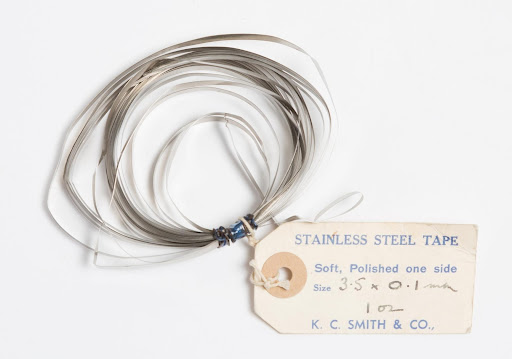
In the late 1960s, the Begg technique began to grow in popularity. Developed by an Australian dentist, Paul Begg, the technique first tipped teeth and then righted them in three stages. It required a lot of complicated wire bending and Begg worked with the metallurgist A.J. Willcock to develop a new type of wire for use in Begg treatment.
Advances in the 1970s led to bonded brackets, Ni-Ti wires and readjusted brackets. These did away with the need for bands and complex wire bending and made fixed appliances more effective and easier to fit.
In the 1980s self-lighting, brackets began to appear. These brackets had a clip to hold the wire in place and no longer required the arch wire to be tied in or held in place with an elastic band.
All Fixed Appliances

Vulcanite
The introduction of vulcanite in the 1850s was one of the revolutionary moments in the history of dentistry and orthodontics. Firm, durable, affordable and with the ability to be moulded to the patient’s mouth, it was a huge improvement on the ivory or precious metals previously used.

Twin Wire
Joseph E. Johnson developed the twin wire technique in 1929. It was based on the principle that two light (.010 inch) wires would work more physiologically that one heavy wire.
Ripple brackets
The ripple bracket evolved from orthodontists trying to find a bracket which was easy and cheap to construct as at this time they had to construct all the parts of an appliance themselves.

Edward H. Angle
Edward H. Angle (1855 – 1930) was the most influential orthodontist of the 20th century; putting orthodontics on a scientific basis and making it an independent specialty of the medical profession.

Edgewise appliance
The Edgewise appliance was first described by E. H. Angle in 1925 as a method to achieve his concept of normal occlusion. The Edgewise bracket had a labially facing rectangular slot into which fitted a rectangular arch wire.

Begg
The Begg technique was a fixed appliance technique developed by the Australian dentist Raymond Paul Begg in the 1950s.
