


Ripple brackets are a simple type of bracket used for fixed appliances. They became popular after World War 2 when orthodontists needed an alternative for the Edgewise bracket which they could no longer import from America.
The ripple bracket evolved from orthodontists trying to find a bracket which was easy and cheap to construct as at this time they had to construct all the parts of an appliance themselves.
At a meeting of the British Society for the Study of Orthodontics meeting on 5th May 1947 Beresford gave a demonstration on the twin wire technique which included a bracket he called the ‘W lock’. This bracket was pressed from stainless steel tape using pliers in a similar way to the ripple bracket. Mills was the first person to use the name ripple bracket in 1959 in a paper about the Johnson twin wire.
“The anterior part of the arch is ligated to the bands by means of “ripple brackets”…These are pressed from stainless steel tape 2.5mm wide by 0.2mm thick. They are welded to the band and their position should be such when the teeth are finally alined the brackets will be level to each other.”
From “Uses and Modifications of the Johnson Twin Wire Arch”, J.R.E. Mills, Transactions of the BSSO, 1959, pp34-43.
By the 1960s Edgewise brackets were once again available and the Begg technique had risen in popularity. The introduction of the pre-adjusted Edgewise bracket in the late 1970s saw the Ripple bracket consigned to history.
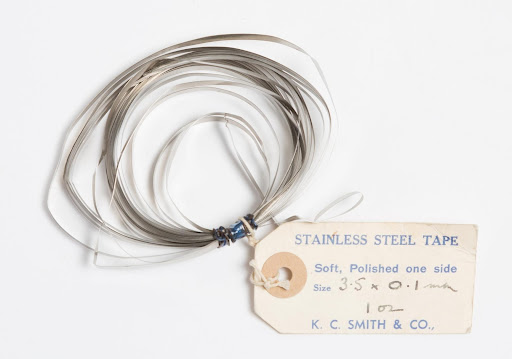
Stainless steel tape
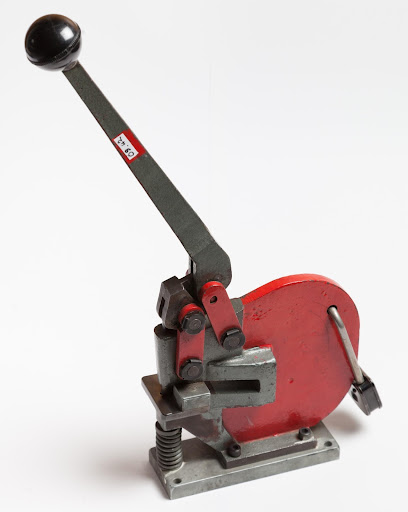
Ripple bracket press

Ripple bracket pliers