


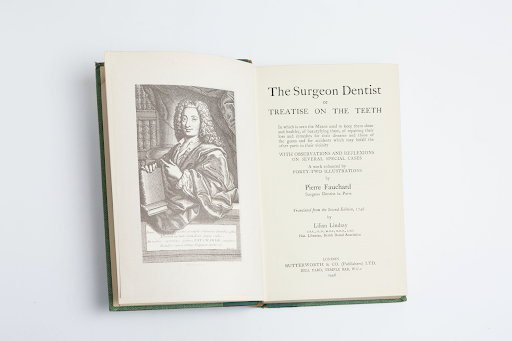
In 1728 Pierre Fauchard, a successful Parisian dentist, published his work Le Chirurgien Dentiste (The Surgeon Dentist). It was the first work to give a scientific basis to dentistry. Fauchard’s work was revolutionary, as it was not common for dentists to share knowledge about their practices.
Le Chirurgien Dentiste comprised of two volumes and was over 800 pages in total. The majority of the book was dedicated to dental practice and provided detailed descriptions of 103 dental diseases and gave instructions on treatments, including the first guide on the construction of dentures.
Two chapters of Le Chirurgien Dentiste were dedicated to ‘Twelve observations on deformed and poorly arranged teeth’ and ‘Tortuous teeth, badly arranged and luxated, instruments and remedies that are useful in operating on them when dentists straighten and stabilise them.’
In these chapters Fauchard described the first orthodontic appliance, the bandeau. It was a silver or gold arch designed to expand the arch. The arch was ligated to the teeth by waxed silk ligatures, which applied pressure to the teeth. The principles of the bandeau were used as the basis for Angle’s E-Arch.
Fauchard suggested filing teeth to reduce their width. To correct the alignment of teeth, Fauchard suggested repositioning teeth with a type of forceps called a pelican, and then ligating the newly positioned teeth to each other.
‘He shakes the tooth on which the hook of the pelican rests, gently… the loosening accomplished he passes to the left side and places his left thumb and first finger on the two teeth which are next to the one just loosened, the other fingers steady the chin. Then he…seizes the tooth with the straight pliers which he holds with his right hand, giving a little twist of the wrist to rotate the tooth as much as necessary. He brings it thus into its natural position, fastening it with waxed thread in the same way as the preceding teeth.’