


The prosopometer was first demonstrated by Dr. Sim Wallace at a BSSO meeting in May 1909.
In the early 1900s interest was growing in the development of the head and jaws. George Northcroft was carrying out the first 3D study of jaw development by taking annual plaster casts of his children’s faces and the prosopometer was invented.
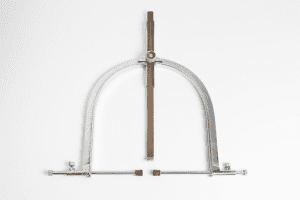
The prosopometer was an instrument used to take measurements of the face and jaws. From the 1910s to the 1930s several examples were demonstrated at BSSO meetings, each with improvements to make the measurements more precise and accurate.
The first prosopometer was invented by Dr Sim Wallace and was demonstrated at a BSSO meeting in May 1909. Sim Wallace was carrying out studies to understand the causes of malocclusion and developed the prosopometer to measure the relationship between points in the sagittal plane to the transmeatal axis.
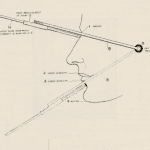
In 1910 improved versions were developed by F.G. Armin 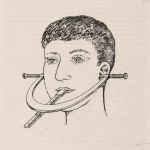
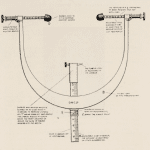 who’s instrument had a more rigid arc with a more accurate measuring system, and by George Northcroft. Northcroft’s version, which was shown in 1911, was adapted for measuring the antero-posterior position of the maxillary or mandibular first molars as well as three other standard measurements.
A prosopometer was displayed at the May 1912 BSSO meeting. The Transactions of the BSSO do not record who designed this version of the instrument but the Transactions do include drawings of it in use. The instrument was used for measuring the distance from the external auditory meatus to the various points on the face to help understand the process of growth and to assist in diagnosing malocclusion.
In 1927 Miss K.C. Smyth demonstrated a prosopometer designed by Mr N.G. Bennett in conjunction with the Cambridge Instrument Company. Bennett’s version was of a more complicated design with a tripod which allowed the instrument to balance around the head. Measurements were recorded on a chart attached to a plate fixed to one side of the arch. Ear plugs kept the instrument in place. The prosopometer required two people to operate it but it recorded much more accurate results than previous versions.

Bennett’s prosopometer
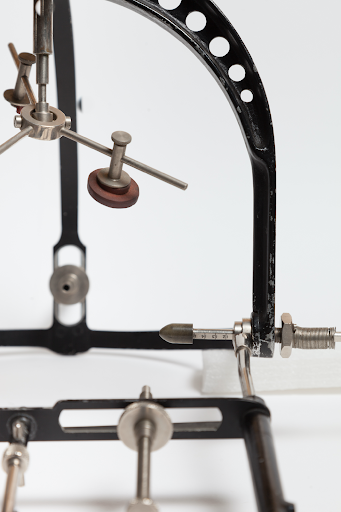
Detail of Bennett’s prosopometer showing the tripod, ear plugs and measuring device.
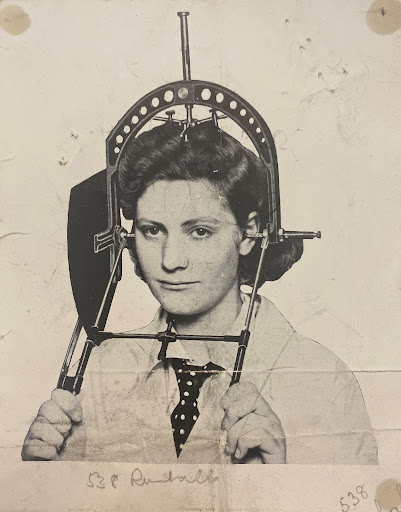
Demonstration of Bennett’s prosopometer held at George Northcroft’s Harley Street practice.