


Sustainability Case Study; Vikki Elton
I work primarily as a Consultant Orthodontist at the University Dental Hospital of Manchester. I have taken a keen interest in environmental issues for many years and am the queen of recycling at home. I drive my friends, family and colleagues crazy with my need to reduce, reuse and recycle everything I can. Luckily, I found a group of like minded individuals at work around six years ago when The Green Team was set up. We are a multidisciplinary group within the Dental Hospital who meet quarterly and attempt to improve the sustainability of our aging building as well as the behaviours of the people who work within and visit it. As a standalone building about 1/2 a mile from the Trust’s main site this frequently poses us significant challenges and occasional advantages.
The Green Team have been lucky to achieve platinum status for the Dental Hospital over the past few years as part of our Trust’s Green Impact Scheme. Each year we have focussed on a different area of sustainability to attempt to improve.
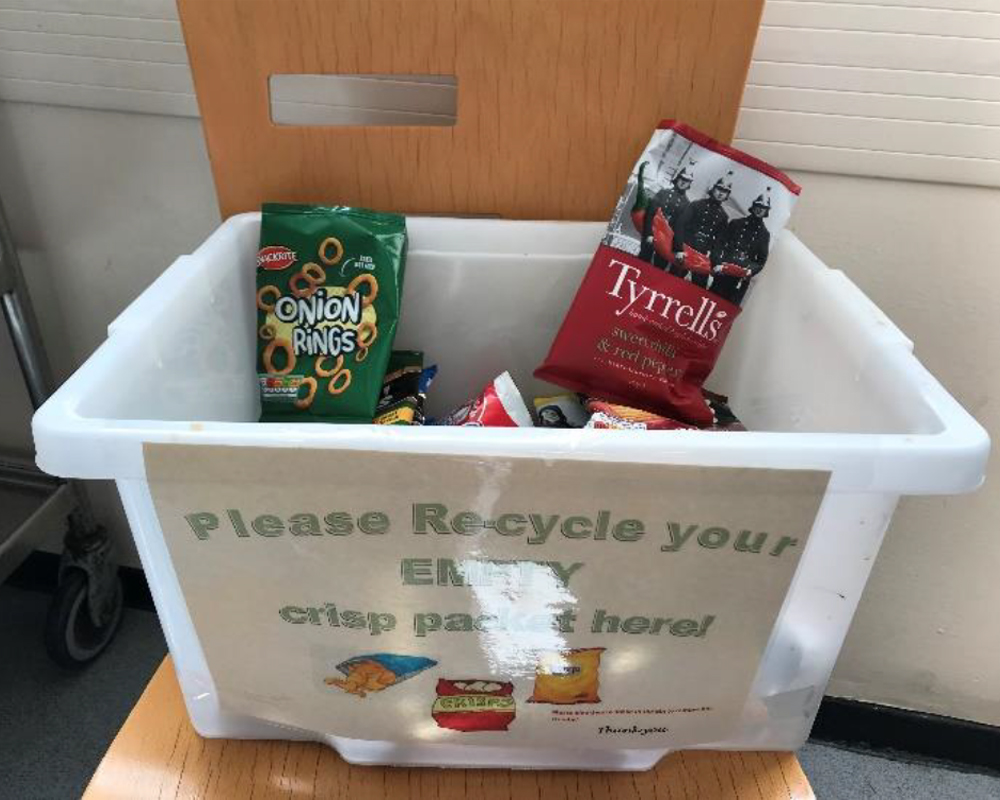
Recycling has been a huge issue for us. Being remote from the Trust’s main site means we have no service available to us for the collection of waste for recycling. In this area we have truly hit a brick wall which is extremely frustrating. Thus we can only encourage staff members and patients to take their waste for recycling home with them and thus sadly much of the waste which could be recycled ends up in general waste bins; a truly depressing situation. We have however, achieved small wins. We identified that crisp packets were a large part of our non-recyclable waste and we found that we could recycle these locally. We therefore decided to put in place an opportunity for staff to recycle their crisp packets as we could ourselves take responsibility for recycling them in the community. Thus we have a box in the staff canteen for the collection of the packets and every so often yours truly hauls huge bags of crisp packets to the local recycling facilities much to the amusement of my children who think I must eat scores of packets of crisps every day.
This has been very successful and we would like to extend the scheme to others currently non recycled items such as cans and plastic bottles (though maybe I will need a bigger boot!). However, we will continue to push our Trust to provide collection services for recyclable items which would allow us to provide up a full range of recycling bins within the hospital and recycle much more effectively.
In the staff canteen we have also removed all plastic cutlery and replaced it with bamboo. Although this has not been a popular move with some people, the reduction in plastic waste from this small change has been immense. The bamboo cutlery is more expensive but the Trust was able to negotiate a reasonable deal for us and the environmental gains offset the small increase in costs. We are also researching the feasibility of selling bamboo toothbrushes in addition to or even instead of plastic brushes within the hospital.
Our Green Team placed a successful bid for monies to replace the corridor lighting within the hospital with motion sensitive lights so as to reduce our electricity consumption. Previously lights would often be left on all night and over the weekend. We have also been successful in funding the installation of a time clock on the dental air plant so that it no longer runs at the weekends. It is certainly worthwhile investigating the energy consumption patterns within your hospitals and practices to see whether this can be reduced out of hours.

We have done much work on clinical waste segregation. This is certainly not a glamorous topic but repeated auditing of the bins in each clinical area has ensured that the correct bins are always available ensuring that infective, offensive and general domestic waste is disposed of correctly, thus reducing the amount of waste being needlessly incinerated and reducing the costs of disposal of our waste.

We have carefully examined our plastic waste output and were able to implement the exchange of single use suction canisters with a re-usable canister with a disposable liner. The hospital use approximately 30 of these each week equating to 1,500 less canisters being thrown away each year!

Clearly Covid-19 was disastrous from a sustainability point of view; I shudder to think of how many plastic aprons we went through but a few small gains were achieved. Prior to Covid-19 I frequently ranted about the needlessness of providing a plastic cup for a mouth rinse for every patient we saw. The avoidance of AGP’s and along with this patients being discourage to rinse their mouths out while in the dental chair has changed the mindset of our teams and now a mouth rinse is only provided if the patient requests it. A small win but significantly less plastic cups are now being disposed of each day in my building. We have also questioned the need to use so many dappen dishes and other single use plastics and will keep pushing through small changes.
Covid also led to an increase in the number of virtual clinics being provided in our hospital. Travel has a significant impact on the overall carbon footprint of dental provision. Thus reducing the number of face to face appointments, where possible, through the use of virtual consultations has hopefully significantly reduced our environmental impact.
3 tips for sustainability
- Consider whether some of the single-use plastics we constantly use could be swapped out for more sustainable alternatives such as autoclavable suction tips, paper cups for rinsing and glass dappen dishes.
- Look at energy usage in your building and encourage lights and computers to be switched off at the end of each day. Ensure heating and electricity does not run all night and all weekend in your building/department. Push to swap light fittings to LED to further reduce energy use.
- Always ensure waste is properly segregated. The autoclavable pouches or mounds of paper wrapping that our kits are enclosed in do not need to be disposed of in the clinical waste bins. They should be put in the general domestic waste reducing both the cost of disposal and the need to incinerate waste unnecessarily.


