


Before brackets could be bonded directly to the teeth, they had to be fitted to bands that were cemented onto the teeth. This technique was first used in 1871 by William E. Magill. Angle’s Edgewise system, which was introduced in 1925, was the first widely adopted system for treatment of malocclusions which used brackets soldered to metal bands.
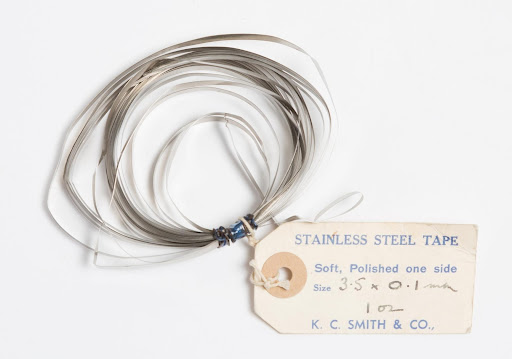
Stainless steel tape

Visick pliers used for forming bands
Prior to the introduction of stainless steel in the 1930s, 14-18 carat gold was the main material used for brands and brackets making appliances extremely expensive. Stainless steel revolutionised fixed appliances and made them much more affordable. Bands were constructed from stainless steel tape which came in different widths and thicknesses for different teeth. The tape had to be formed into bands using special pliers and then welded or soldered together by the orthodontist at the chair side. Having bands fitted could be an extremely unpleasant and uncomfortable experience for the patient. To help with fitting, brass and later rubber separators were placed between the teeth about a week before to make space for the bands to fit.
Brackets were often simple in design and were fabricated from stainless steel strips using a special punch or press. Examples include the Watkin pin and tube, the McKeag box and the ripple bracket. The ripple bracket was especially popular after the Second World War when Edgewise brackets from America were unavailable. Orthodontists continued to make their own brackets until the 1960s when European manufacturers started to produce commercially available brackets.
An attempt at improving the look of fixed appliances led to clear plastic brackets being introduced in the 1970s. Initially acrylic was used and then injection moulded polycarbonate but there were many problems with staining, odour, distortion and breakage. In the 1980s ceramic brackets were introduced. They were more resilient than plastic but still had problems with breakage.

Fully banded model with ripple brackets.
The discovery of acid etch bonding in 1955 revolutionised fixed appliances as brackets could now be attached directly to teeth. This discovery was followed by Newman’s use of a cold cure epoxy adhesive in the 1960s. Although these early adhesives were time consuming and could cause bracket failures, they led to many advances in bonding techniques making fixed appliances easier to use and more effective.

Begg appliance with bonded brackets, c.1970

Commercially available bands in a band box